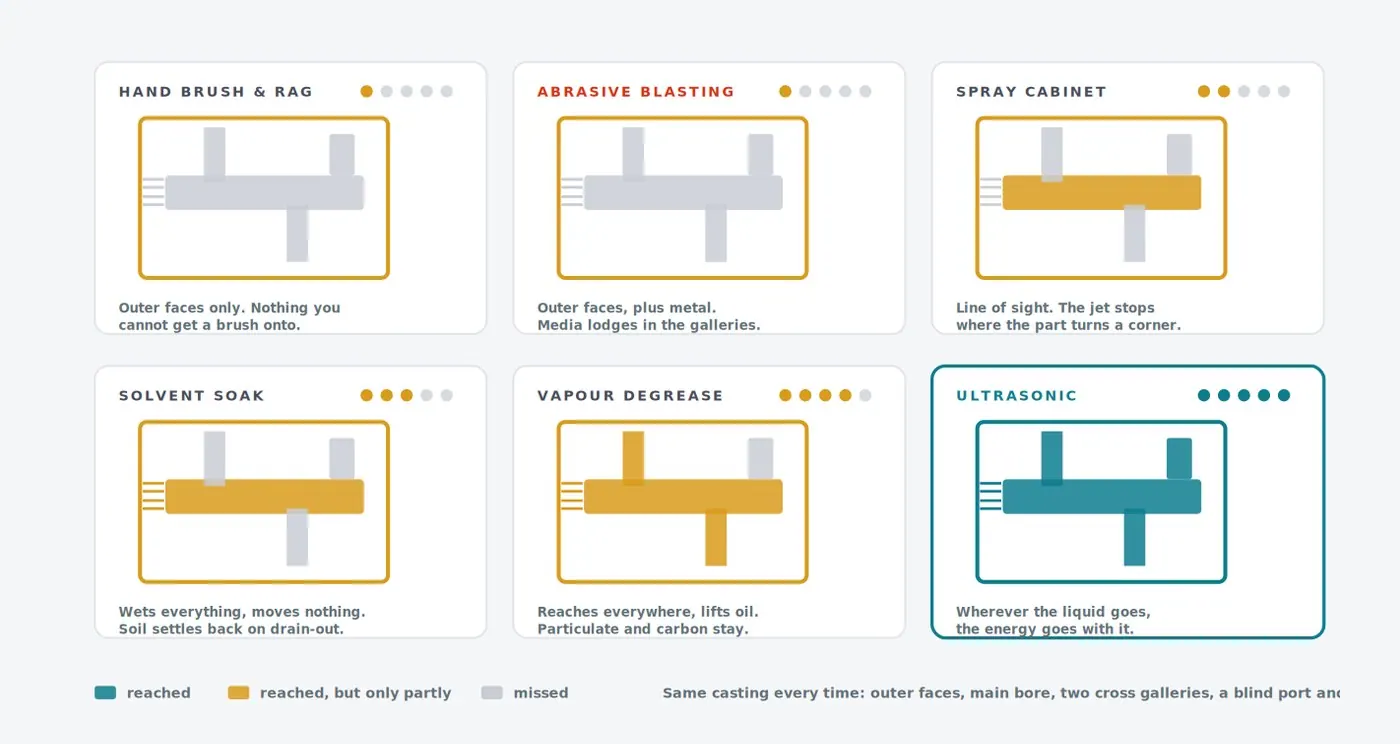
Six ways industry gets parts clean, including the jobs where ultrasonics is the wrong answer. Knowing where a method fails is the only honest way to judge where it works.
Every cleaning method is a way of putting energy into contamination. Muscle does it. So do pressure, abrasive impact, solvency, heat and cavitation. They all work. What separates them is what else the energy does on the way to the soil: how much of it lands on the part, and where it cannot reach at all. Six methods below, with the jobs each one owns and the jobs it should be kept away from.
Flexible, no capital outlay, and expensive from the first minute once you multiply minutes by an award rate. The bigger problem is that two operators never produce the same part. A scraper finds soft metal. A wire brush rounds the edges that seal. Neither reaches inside a gallery or a blind hole, so on anything with internal geometry hand cleaning is not really in the comparison. It keeps its place as a pre-clean: thirty seconds with a rag ahead of a tank stage saves the tank a great deal of work. More on that in the process article.
Fast on big accessible surfaces, and nothing beats it for getting mud off a loader. The limit is line of sight. A jet stops where the part turns a corner, so blind holes get cleaned by hope, and at close range the spray can drive contamination further into galleries and bearings rather than out of them. Then there is the water to handle and the mist to contain, neither of which tends to appear in the quote. Spray does good work as the bulk-removal stage of a multi-stage machine. It makes a poor last stage.
On heavy corrosion and coatings it is genuinely fast, and for structural steel heading for paint it is the right call. On precision components we would rather you did not. Blasting removes parent metal. It rounds the edges that seal. In soft alloys the media embeds itself, and embedded media has a habit of working loose weeks later and circulating through the assembly it was supposed to be protecting. Aluminium and zinc diecast are the usual casualties. The finish looks excellent, which is the part that makes it hard to argue with on the shop floor.
On fresh oil and grease a solvent works on the like-dissolves-like principle, and works well. It stalls on anything that has changed chemically since it arrived. Baked carbon, varnish and scale are no longer similar to anything the solvent can grab, so the part comes out of the bath with the films gone and the hard deposits sitting exactly where they were. Add the disposal paperwork, and the flammability rules that apply near any heat source, and the plain solvent bath is down to a handful of niches it still does better than anything else.
For final-stage oil removal at volume this is still the best method there is. Distilled solvent condenses on the cool part, runs off carrying the oil with it, and does the same thing every cycle inside a sealed machine. What it will not do is move a particle. Swarf, grit and inorganic scale come out of a vapour degreaser as they went in, so it finishes a part rather than cleaning one. It is also expensive to buy and increasingly restricted in what you are allowed to put in it. Where a customer specification calls for vapour, we supply the fluid and say so.
Cavitation carries its energy in the liquid, so the energy goes wherever the liquid goes. Blind holes, cross-drillings, thread roots, the inside of a tube bundle. It arrives there at full strength and nothing mechanical touches the surface. With the chemistry matched to the soil, one cycle takes off particles and films together, at a time and temperature you can write on a process card and repeat. The limits are real enough. Some parts are larger than any practical tank. Some soils never make liquid contact. And on genuinely crude work a pressure washer is quicker, and we will say so.
| Method | Reaches hidden geometry | Touches the part | Repeatable | Best at | Watch out for |
|---|---|---|---|---|---|
| Hand | No | Yes — hard | Operator-dependent | Gross pre-wipe, odd jobs | Labour cost, damage, variability |
| Pressure / spray | Line-of-sight only | Water impact | Fair | Bulk external soil | Drives soil deeper, mist, water handling |
| Blasting | Line-of-sight only | Yes — abrasive | Fair | Corrosion & coatings pre-paint | Metal loss, embedded media |
| Solvent soak | Wherever liquid sits | No | Fair | Fresh oils & greases | Stalls on carbon/scale, compliance |
| Vapour degrease | Yes (condensing) | No | Excellent | Final-stage oil removal at volume | Capital, solvent rules, no particles |
| Ultrasonic | Yes — full intensity | No | Excellent — logged | Complex parts, mixed soils, spec cleaning | Needs right chemistry & degassed bath |
Two rows reach hidden geometry without touching the part: vapour degreasing and ultrasonics. Of those two, only ultrasonics also removes particles, runs on water-based chemistry, and scales from a benchtop unit to 46,000 litres. That is why it sits at the centre of most modern cleaning lines. It is also why the honest answer to "which method" is often "two of them, in this order".
Internal and complex geometry. No other method delivers full cleaning energy into a gallery, a cross-drilling or a tube bundle without line of sight to it.
Dimension-critical parts. Nothing abrades and nothing embeds, so no metal leaves the part. A ring groove gauges the same after the cycle as before it. For rebuilders and MRO shops that one fact usually settles the question on its own.
Mixed contamination. Particles and films come off in the same cycle. Jobs that would otherwise be chained across two or three methods collapse into one.
Auditable repeatability. Time, temperature, concentration and frequency are set on the machine and logged, so basket forty runs the cycle basket one ran. Writing an SOP for hand scrubbing that an auditor will sign is a harder afternoon.
Labour release. The tank runs unattended. Whatever the operator was going to spend those twenty minutes doing, they can spend them on skilled work instead, and on most sites that is where the payback calculation stops.
Most method comparisons stop at what each one can clean. In practice the argument is usually settled by what each one costs once it is running.
Hand cleaning bills you for every minute, at an award rate, indefinitely. Blasting bills you twice: once for media, and again in rework when embedded grit finds its way back out. A solvent program pays compliance rent that goes up rather than down.
An ultrasonic line runs the other way round. The capital goes in at the start. After that the running cost is chemistry and power, and it falls per part as volume rises, because the tank does not much care whether there are six parts in the basket or sixty. Where the crossover lands depends on your labour rate and your volume, and we are not going to pretend to know it before we have seen both.
Machined brass lock bodies, casings and plugs go from as-machined to assembly-ready in a twenty-minute cycle: hot degrease at 60 °C, demineralised rinse, then hot air and vacuum drying at 110 °C. The operator loads the basket and walks away. Documented Misonics trial T-3173. Parameters are for that part family and are re-established for each new one.
The table above is not static. Every few years a method narrows, and lately it has been the solvents.
The US EPA finalised its methylene chloride rule in 2024. Consumer paint-stripping uses went first, and the deadline for most remaining commercial uses passed in April 2026. Other jurisdictions are heading the same way. Shops that ran an MC strip tank have already had to find something else.
The drop-in replacements do work. Benzyl alcohol and dibasic esters will strip a multi-coat part. They are simply slower, because they tend to work a layer at a time, and what took minutes in MC takes hours. The way to get the speed back is to add energy rather than to hunt for a stronger solvent: heat the chemistry and cavitate it. That is the Alloy System pattern for strip work, and the aqueous-ultrasonic pattern everywhere else. Every solvent that leaves the market makes that argument easier to have.
Hard carbon lifted from ring grooves by heated chemistry and cavitation, with the groove gauging the same afterwards. The work an MC bath used to be pointed at.
Read the case study →Structural steel heading for paint wants blasting. Mud on a chassis wants a pressure washer. A one-off oddball with easy access may never justify a tank at all. Very-high-volume final oil removal to a solvent specification belongs in vapour plant, and if that is your job we will quote you the fluid and leave the machine out of it. When parts land in one of those categories the trial report says so. That is a cheaper conversation for both of us than a machine you resent owning.
Three things tell us ultrasonics is likely to fit: you clean the same family of parts repeatedly, the soil is mixed or the geometry is internal, and either the dimensions or the documentation matter. Two out of three is enough to be worth running a trial on a box of your parts.
Tell us the part, the contaminant and what it has to pass. Technical sales will say which of the six is right for it, including when the answer is one we do not sell.